Are you currently competing in the “Overthinking Olympics”?
We have all been there. You send a message, it gets seen, but there is no reply—suddenly you are convinced the relationship is ruined. You make a minor error at work, and your mind spirals into a narrative where your career is over.
According to monk and life coach Gauranga Das, overthinking isn’t just a habit; it is “mental confusion” that steals our sleep and peace. Perhaps the most startling statistic he shares is that 99% of the worst-case scenarios we obsess over never actually happen.
Drawing from the wisdom of the Bhagavad Gita and modern psychology, here is a breakdown of why we overthink and three practical ways to stop it.
The Root Cause: It’s Not Thinking, It’s Fear
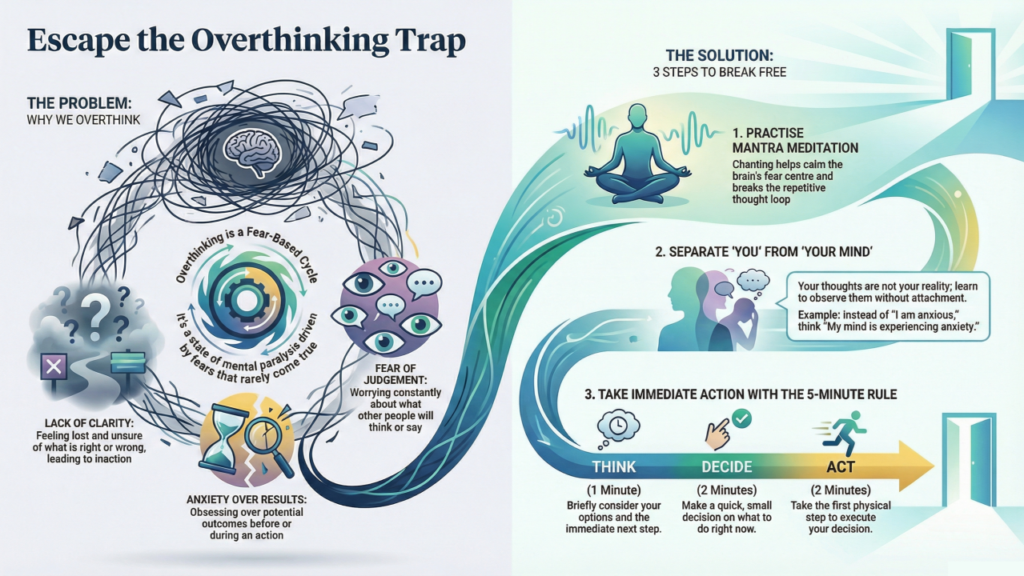
Overthinking isn’t just an intellectual bad habit; it is a manifestation of inner fear. This fear settles in the mind, forcing us to prepare for disasters that are unlikely to occur.
There are three primary triggers for this fear:
- No Clarity: Being unsure of right vs. wrong creates a mental loop.
- Fear of Judgment: The crushing weight of “What will people say?”
- Attachment to Results: This is the big one. We worry about the “fruit” of the action (the promotion, the praise) before we have even done the work.
This leads to what we call “Paralysis by Analysis.” Even the great warrior Arjuna faced this on the battlefield, frozen by the potential consequences of his actions.
3 Practical Solutions to Break the Loop
If you want to turn your mind from an enemy into a friend (Bandhu), try these three steps:
1. Hack Your Physiology with Mantra Meditation Overthinking activates the amygdala, the brain’s fear centre. You cannot always “think” your way out of a fear response; sometimes you must physically calm the system.
- The Fix: Research shows that chanting (Mantra Meditation) reduces amygdala activity and relaxes the heart rate.
- The Mindset: Chanting a mantra signals to your brain that “I am not the controller.” This act of surrender breaks the exhausting loop of trying to micro-manage every outcome.
2. Practice Cognitive Distancing “Thoughts are not reality.” Just because your mind tells you that you are a “failure” or that “everything is against you,” it does not make it a fact.
- The Fix: Separate your Self from your Mind. Instead of saying, “I am worried,” reframe it as, “My mind is creating a negative narrative.”
- The Mindset: By observing the thought rather than becoming it, you dismantle the structure of overthinking.
3. The 5-Minute Rule (Action Over Inaction) We often get stuck in a cycle of thinking without doing. The wisdom here is simple: Action reduces fear; inaction multiplies it.
The Fix: Apply the 5-Minute Rule to any decision:
- Think (1 Min): Is this necessary?
- Decide (2 Mins): Yes or No.
- Act (2 Mins): Do it immediately.
The Mindset: By condensing the process, you leave no room for the mind to wander into doubt.
The Takeaway
The Bhagavad Gita teaches us Karmanye vadhikaraste ma phaleshu kadachana—you have a right to your labour, but not to the fruits of your labour.
When we stop trying to control the uncontrollable future and focus entirely on the present action, the “Overthinking Olympics” finally come to an end.